Stranger Things: Who Are You?
- 4.3
- Rating
- 10.00K
- Installs
- Free
- Price
 Analysis by App-foxy
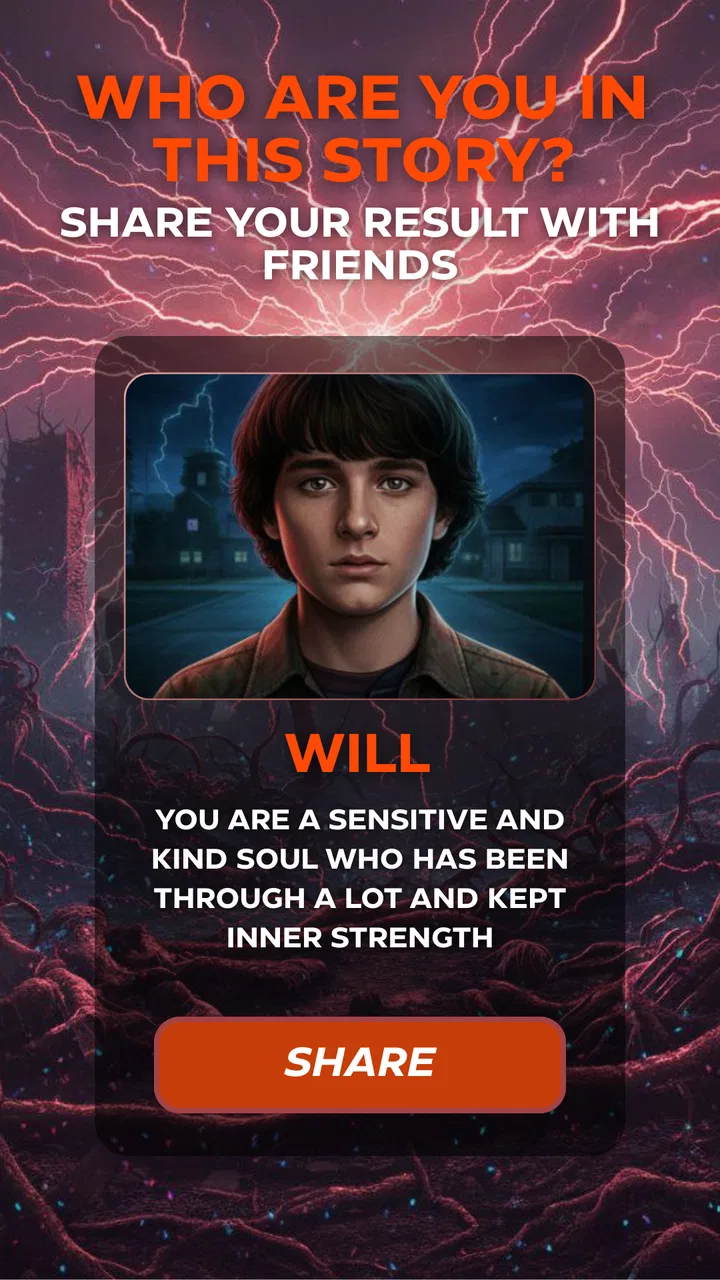
I tried Stranger Things: Who Are You? as a light trivia game built around the world of Stranger Things, and my first impression was easy to understand: it is the sort of quiz you open when you want a quick bit of fandom fun rather than a deep game session. The central idea is simple—answer questions and see which character or identity from the Stranger Things universe best matches you. That makes it immediately approachable, especially for someone who enjoys discussing the show with friends.
What matters here is not complexity but recognition. The appeal comes from seeing familiar themes, characters, and situations reflected in a personality-style quiz. I found that the experience works best when I treated it as a conversation starter: take the quiz, compare the result with someone else, and argue playfully about whether the outcome feels accurate. It is less convincing as a serious test of personality, but that is not really why this kind of game exists.
How the first week feels
During the first few sessions, the game benefits from being extremely easy to understand. There is no long learning curve to overcome, and the Stranger Things setting gives the quiz an identity right away. The store description is brief, but the actual premise is clear enough that a fan can begin without studying instructions or learning a complicated control scheme.
You May Also Like

 AccuWeather: Weather Radar
AccuWeather Review: A Quick, Clear Forecast for Everyday Decisions
For everyday plans, the best forecast is the one you can understand quickly. AccuWeather makes rain timing, radar, and local conditions easy to act on, with a few trade-offs.

 Hill Climb Racing
Why Hill Climb Racing Still Turns Crashes Into One More Run
A tiny car, a bumpy hill and one more upgrade: Hill Climb Racing keeps resurfacing because its simple chaos makes every near-miss feel personal.

 AliExpress - Shopping App
AliExpress Makes Global Shopping Feel Personal, but Shoppers Bear the Risk
AliExpress turns a global marketplace into a pocket-sized discovery engine. Its reach is useful, its shopping loop compelling, and its trade-offs easy to miss.

 Lords Mobile: Kingdom Wars
Lords Mobile Is a Kingdom-Building Routine, Not a Quick Match
A case-by-case verdict on the building, battles, device demands, and social commitments that make Lords Mobile rewarding for some players and exhausting for others.

 PDF Scanner app - TapScanner
TapScanner Makes Paperwork Easier to Capture, Check, and Share
TapScanner makes scanning with a phone feel less like a rescue operation and more like a dependable step in getting work done. Its capture tools are useful, though not flawless.

 Block Blast!
 Shows How Much a Puzzle Game Can Leave Out
A quiet grid game shows why puzzle players increasingly value instant clarity, repeatable skill and low-pressure play—and where the genre still needs to catch up.
More From Our News Desk
View All News


I would recommend starting it when you have a few spare minutes, perhaps while waiting for an appointment or relaxing before bed. The format suits short attention windows because the purpose is immediately visible: answer the quiz and discover the kind of Stranger Things character you resemble. That directness is one of its strongest qualities, particularly for casual players who do not normally spend time with trivia games.
The first result is naturally the most interesting moment. Before seeing it, I was curious whether the questions would lead toward a familiar favorite or produce a more unexpected match. That small sense of anticipation gives the game its first-week appeal. Even when the result feels predictable, it creates an opening for discussion: do the answers really describe you, or did you choose them based on the character you wanted to get?
The best early use is social rather than solitary. I can imagine passing the phone around during a Stranger Things conversation, letting each person answer for themselves and comparing the outcomes. It also works as a small icebreaker for friends who already know the series. The quiz does not need to become a major event; its strength is that it can add a few minutes of amusement without demanding a full evening.
The game is free, which makes that first try easy to justify. Its Everyone content rating also makes it suitable for a broad audience, although younger players may still get more from it if they already know the show and understand the references. Someone unfamiliar with Stranger Things could technically open it, but the character-based premise will be much less meaningful without that background.
The current version is 1.3, and I found the overall concept more important than any expectation of a large, constantly changing game system. This is a focused quiz, not a role-playing game or an exploration experience. That distinction is worth making early because a player looking for action, story progression, or a substantial trivia library will probably feel that the experience is too narrow.
What makes the first result worthwhile
A useful way to approach the quiz is to answer honestly on the first attempt, then consider taking it again only if you want to compare how a different mood affects your choices. Choosing every answer to force a favorite character can still be funny, but it changes the activity from self-discovery into a character hunt. I preferred treating the result as a playful interpretation rather than a definitive label.
That approach also helps avoid one common disappointment with personality quizzes: expecting scientific accuracy. This game is entertainment, and its value comes from the connection to the Stranger Things universe. If you want a measured psychological assessment, this is the wrong tool. If you want a quick fandom prompt that gives you something to talk about, it makes much more sense.
Does it keep its place after the novelty?
The harder question is what happens after the first week. Most quiz games have a strong opening because the initial result is new. Once you know what outcome you received, the reason to return becomes less obvious. In my experience, this game has recurring value mainly when the context changes—when a friend has not tried it, when you want to compare answers, or when you are revisiting the series and feel like returning to its world.
That is not necessarily a weakness, but it sets realistic expectations. I would not make this a daily habit in the same way I might use a word puzzle or a general knowledge game. The experience is tied closely to its single theme, so its replay value depends on how much enjoyment you get from examining the result again or sharing it with other people.
For a fan group, the lifespan can be longer. One person may answer quickly, another may debate every choice, and a third may deliberately select unusual responses to see whether the result changes. In that setting, the quiz becomes a small recurring activity rather than a one-time test. The important distinction is that the repeat value comes from people and conversation, not from a clearly expanding progression system.
I also see a use for it during a themed viewing night. Before watching an episode, everyone could take the quiz and compare their results; afterward, the group could revisit whether the characters’ decisions changed anyone’s opinion. That kind of use gives the app a reason to return without pretending it offers endless content. It becomes a companion to fandom rather than a replacement for the show or a full trivia platform.
Compared with a broad trivia game, this one is more personal but less varied. General trivia apps can keep challenging you with new subjects, score tracking, and wider knowledge categories. A Stranger Things personality quiz has a more focused emotional hook, but it cannot compete on breadth. I would choose this game for themed fun and choose a conventional trivia app when I want to learn facts, improve a score, or play repeatedly without exhausting the subject.
Who will still enjoy it later?
The strongest long-term audience is someone who likes character comparisons and enjoys sharing results. It is also a reasonable choice for a casual fan who does not want to memorize production details or answer difficult lore questions. The game’s accessible premise lowers the barrier to participation, especially when the goal is simply to see which fictional personality feels closest.
On the other hand, dedicated trivia experts may find it too soft. If you are looking for obscure references, escalating difficulty, timed rounds, or a large question bank, this is unlikely to replace a more substantial quiz title. Likewise, a player who has no interest in Stranger Things has little reason to keep it installed. The theme is not decoration; it is the entire reason the game stands out.
Maintenance, friction, and reasons it may fade
One advantage of a small quiz is that it demands very little maintenance from the player. I did not need to build a routine around it, manage a profile, or commit to regular sessions. It is the kind of game that can sit unused and still make sense when opened later, because the basic activity is immediately understandable.
That low commitment is useful, but it also reveals the main limitation. There is not much of a personal archive to maintain. If you are the kind of player who enjoys collecting achievements, improving a leaderboard position, or watching a long-term record develop, the experience may feel thin. The game gives you a result to discuss, but not necessarily a broader reason to organize your time around it.
The developer is yu.lexa, and the game has an average rating of 4.3 from around 65 ratings, with three written reviews shown alongside it. That reception suggests that the core idea is landing reasonably well with the people who have rated it, but I would still interpret the numbers carefully. A small audience and a focused concept can produce a positive impression without proving that the game will satisfy every kind of trivia player.
It has passed 10K installs, which places it in the category of a small, specialized fan experience rather than a huge mainstream game. I actually think that fits the product. Its appeal is specific, and its success depends more on whether the intended audience enjoys the theme than on whether it can serve everyone.
For everyday use, the main maintenance task is simply remembering when the quiz is useful. I would keep it available if I regularly spend time with friends who like Stranger Things, because the social scenario gives it a recurring purpose. If I mostly play alone and rarely revisit the series, I would probably remove it after the initial curiosity had passed. That is not a technical complaint; it is a question of whether the app earns storage through repeated relevance.
Where fatigue begins
Repetition is the biggest risk. Once the result is familiar, another run can feel like asking the same question in a slightly different mood. A second attempt may be entertaining if you deliberately change your answers, but that can also make the result feel less meaningful. The quiz has to balance playful discovery with enough freshness to justify returning, and a compact concept naturally has limits.
There is also a difference between enjoying the Stranger Things universe and enjoying personality quizzes. A fan may love the show but still prefer a factual quiz about episodes, characters, or story details. Conversely, someone who enjoys personality tests may not care about this particular fictional setting. The game sits at the intersection of those interests, which gives it a clear identity but also narrows its audience.
Another possible source of fatigue is expectation. The title may lead some players to imagine a larger interactive experience where they enter the world of the series, make choices, or unlock characters. That is not how I would frame it. I approached it as a short trivia-style identity quiz, and that made the simplicity feel intentional. Anyone expecting a full Stranger Things game should adjust those expectations before downloading.
My practical tip is to avoid judging it by the standards of a long-form game. Use it in short bursts, with friends, or as a themed extra alongside the show. If you try to turn it into a daily challenge without a personal reason to return, the limited format will become noticeable much faster. If you use it occasionally, its lightness becomes a benefit rather than a problem.
My long-term verdict
After looking beyond the first-result excitement, I see Stranger Things: Who Are You? as a pleasant niche quiz with a clear purpose. It earns a place on my phone when I want a quick, free activity connected to the Stranger Things universe, especially when I can share the result with someone else. It does not earn permanent space simply because it is based on a popular series; it has to remain relevant to my social plans or current fandom interest.
I would recommend it to casual Stranger Things fans, younger players who enjoy character quizzes, and groups looking for a simple conversation starter. The Everyone rating supports its broad accessibility, while the straightforward format means you can understand the appeal almost immediately. It is also a low-risk download because there is no purchase price standing between curiosity and a first try.
I would skip it if I wanted a deep trivia challenge, a long progression system, detailed statistics, or a game with strong reasons to return every day. A broader trivia title will be better for learning and replay variety, while a larger licensed game will be better for immersion. This quiz is not competing in either of those spaces, and it is more honest to enjoy it for its small, specific idea.
My final recommendation is conditional but positive: try it when you want a quick Stranger Things-themed personality quiz, then keep it only if the result continues to create conversations or entertaining repeat sessions. The first week is the strongest part because discovery does the heavy lifting. Its lasting value comes from how you use it, not from an elaborate system that constantly pulls you back.
In short, it is best treated as a shareable fandom moment, not a permanent daily game. That may sound modest, but the focused design works when matched with the right expectation. For the right player, a few minutes of playful character comparison are enough to make the download worthwhile; for everyone else, the novelty may fade before it becomes a regular habit.
FAQs for Stranger Things: Who Are You?
01What is the main gameplay of Stranger Things: Who Are You?
Stranger Things: Who Are You? is an interactive story-driven game where players immerse themselves in the world of Hawkins, encountering characters from the series. The gameplay focuses on decision-making and character interactions, allowing you to influence the storyline based on choices you make, making each playthrough unique.
02Is Stranger Things: Who Are You? free to play?
While Stranger Things: Who Are You? can be downloaded for free, it includes in-app purchases for additional content and features. These might include special episodes or cosmetic upgrades. However, players can enjoy the core storyline without spending money, although optional purchases can enhance the experience.
03What are the device requirements to run Stranger Things: Who Are You?
To run Stranger Things: Who Are You?, your device needs to meet minimum operating system requirements: Android 8.0 or iOS 11.0 and above. Ensure you have at least 2GB of RAM and 500MB of free storage space for optimal performance, as well as a stable internet connection for updates and online features.
04Does Stranger Things: Who Are You? contain any spoilers for the TV series?
Stranger Things: Who Are You? is designed to complement the TV series, featuring familiar locations and characters. While it doesn’t directly spoil major plot points, it does explore themes and events related to the series. Watching the show beforehand can enrich your understanding and enjoyment of the game.
05Can I play Stranger Things: Who Are You? offline?
Stranger Things: Who Are You? requires an internet connection for initial download and updates. Some features may be accessible offline, but to fully enjoy the interactive elements and episodic updates, a stable internet connection is recommended. This ensures you stay up-to-date with new content and community events.
Pros
- Immersive storyline true to the series.
- High-quality graphics and sound effects.
- Engaging puzzles and challenges.
- Variety of characters to interact with.
- Offline mode available for play anywhere.
Cons
- In-app purchases can be costly.
- Limited character customization options.
- Occasional lag on older devices.
- Some tasks can feel repetitive.
- Requires substantial storage space.

Stranger Things: Who Are You?
Gallery